

Our Work
HERA brings together geneticists, cell biologists, reproductive scientists and clinicians to investigate the mechanisms that drive reproductive ageing. By combining large-scale human genetic data with experimental systems that capture cellular, tissue-level and whole-organism biology, we aim to define the pathways that influence reproductive lifespan and understand their wider implications for health. Our research is organised into four complementary strands.

Human Genetics
We use genomic and population-scale datasets to identify genetic variants associated with reproductive ageing and related traits. Through approaches including genome-wide association studies and rare variant analyses we map the genes and pathways involved in ovarian function, age at menopause, infertility and related conditions. These findings provide mechanistic hypotheses and guide downstream experimental work across HERA.
Cellular Models
Our cellular research focuses on testing genetic ideas in controlled laboratory systems. Using tools such as CRISPR gene editing, transcriptomic analysis and stress-response assays, we examine how specific genes and pathways influence the behaviour of cells involved in reproductive ageing. These models help us move from genetic associations to biological mechanisms, revealing the molecular changes that drive shifts in reproductive function.

Organoid Models
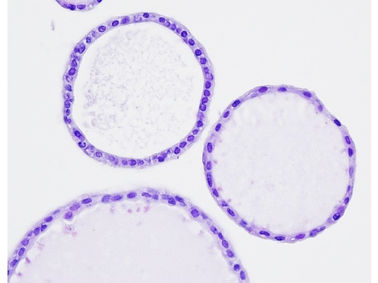
To investigate how ageing affects tissues, we are developing organoid models that mimic key aspects of reproductive organs. These three-dimensional structures enable us to study how genetic changes, hormonal signals and environmental influences shape tissue architecture, function and deterioration over time. Organoids provide a flexible experimental platform for examining complex interactions and processes that are not accessible through conventional cell culture.
In Vivo Models
Reproductive ageing ultimately unfolds within the context of a living organism. Our in vivo work examines how genetic and molecular changes impact reproductive lifespan, endocrine signalling, tissue homeostasis and systemic ageing. These models allow us to validate mechanisms identified in genetic and laboratory systems and to determine their biological relevance and translational potential.
